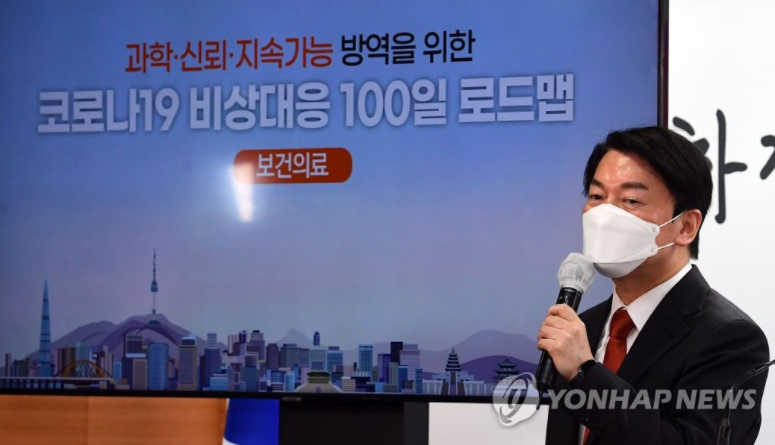
The presidential transition committee, preparing for the inauguration of South Korea's next administration under Yoon Suk-yeol, announced its COVID-19 response plan for the first 100 days after the new government takes office on May 10. The new administration plans to decide whether to lift the outdoor mask mandate around late May. It will also secure hospital beds and personnel in preparation for a resurgence of COVID-19 and implement protective measures for high-risk groups early on. By early August, it will consider applying COVID-19 restrictions based on the degree of density, closeness, and confinement, rather than by industry.
Chairman Ahn Cheol-soo of the transition committee announced the "100-day roadmap" for COVID-19 measures, which was discussed and finalized by the relevant subcommittee. Ahn explained, "Many experts predict a major COVID-19 outbreak in the fall due to new variants. A 100-day roadmap is necessary to complete all preparations before then."
The roadmap outlines the following as its main directions: establishing a system for promoting scientifically based epidemic prevention policies, creating a sustainable infectious disease response system, providing enhanced protection for high-risk and vulnerable groups, and securing safe vaccines and sufficient treatments. It also details tasks to be undertaken within 30, 50, and 100 days after the administration takes office.
Within the first 30 days, the plan includes considering the declaration of "outdoor mask freedom." Ahn stated, "We intend to make a decision around late May based on the situation," adding, "It may become possible if the number of domestic infections falls to the level seen when mask mandates were lifted in advanced countries abroad."
However, it is expected that indoor mask-wearing will remain mandatory even if the outdoor mandate is lifted. The Ministry of Health and Welfare and the Korea Disease Control and Prevention Agency of the new administration will set specific guidelines.
Within 30 days, measures will also be taken to conduct a nationwide antibody prevalence survey, secure hospital beds and personnel for a potential COVID-19 resurgence in the fall and winter, implement protection measures for nursing homes and facilities for the elderly, and develop infection prevention support measures for schools, kindergartens, and daycare centers. Plans will also be finalized for the prompt prescription of oral COVID-19 treatments for high-risk groups and for increasing the procurement of these treatments by 1,009,000 courses, from the currently planned 1,062,000 courses.
Tasks within 50 days include strengthening treatment systems for emergency and special patients and transitioning to a COVID-19 response system centered on general medical institutions such as local hospitals and clinics. A consultative body for infectious disease crisis response will be established directly under the president, and the current daily recovery support committee will be abolished.
Within 100 days, the new administration aims to establish a scientifically based living epidemic prevention system. It will also consider revising the application of the previous social distancing measures. Ahn stated, "We will implement scientific epidemic prevention based on the degree of density, closeness, and confinement," emphasizing, "We will not issue assembly bans that lead to de facto business suspensions for entire industries as before."
Further tasks include constructing a central infectious disease hospital, adjusting the infectious disease classification and reviewing isolation systems, building an integrated epidemic prevention information system, and developing vaccination plans, including for the fourth dose.
For the funding of COVID-19 measures, which have so far utilized the main budget, supplementary budgets, and reserve funds, the establishment of an "Infectious Disease Crisis Response Fund" will be considered for flexible operation. Furthermore, plans include strengthening support for long COVID symptoms and adverse reactions to vaccine administration.
Ahn pointed out that the current administration's COVID-19 policies have unfortunately led to a lack of trust, and based on these issues, stated, "The new administration will respond to the COVID-19 crisis with a governance system that prioritizes expert opinions through the Infectious Disease Crisis Response Consultative Body, rather than making policy decisions in the Blue House as a political judgment."
Article Source: ⓒyonhapnews
 These are English translations of articles from our GTTOUR Japanese website. These are English translations of articles from our GTTOUR Japanese website. |



 NOW! KOREA
 Official Member of the Korea Association of Travel Agents (KATA)


